

Things To Know When Living Near Transmission Lines!

You can’t spend much time around Lake Norman without eventually running into one of these bad boys. After all, when a lake was built for the sole purpose of generating power, you’ve got to be able to move that power to where it’s needed.
These aren’t your everyday neighborhood power lines. They’re high-voltage transmission lines, and in our area they typically operate at around 230,000 volts.
From a real estate standpoint, there are plenty of homes around Lake Norman that sit close to transmission lines. Over the years, I’ve found that buyers usually fall into one of two camps: those who absolutely don’t want to be anywhere near them, and those who couldn’t care less.
I currently have a home listed on Lake Norman that sits roughly 400 feet from a transmission line. After receiving feedback from a potential buyer who was uncomfortable with the proximity, we decided to do something most people never actually do—we brought Duke Energy out to take real-world EMF readings.
They measured EMF (Electro Magnetic Field) levels directly beneath the transmission lines, throughout the yard, and inside the home. They also measured common household appliances for comparison. And to be honest, the results surprised me. I think they’ll surprise you too.
Now, I won’t argue that transmission lines are pretty—they’re not. But I’ve also found that once you spend any amount of time around them, you tend to stop noticing them altogether. More importantly, contrary to what many people believe, these lines pose no measurable health risk to people living nearby.
Before getting into the readings, a little context helps. In the United States, transmission lines typically carry anywhere from 69,000 to 765,000 volts. In North Carolina, the highest-voltage lines in use are 500,000 volts, but the vast majority of transmission lines in and around the Lake Norman area operate at 230,000 volts.
Additionally- while EMF exposure is driven more by current than voltage, voltage is easier for most of us to understand, so we’ll use voltage.
Below are the actual measurements provided by Duke Energy after testing directly beneath the transmission lines and inside the home located approximately 400 feet away. The lines run in front of the house.
Here’s what they found – Keep in mind that the Earths natural magnetic field (which we live in 24/7 is 500 Milligaus.
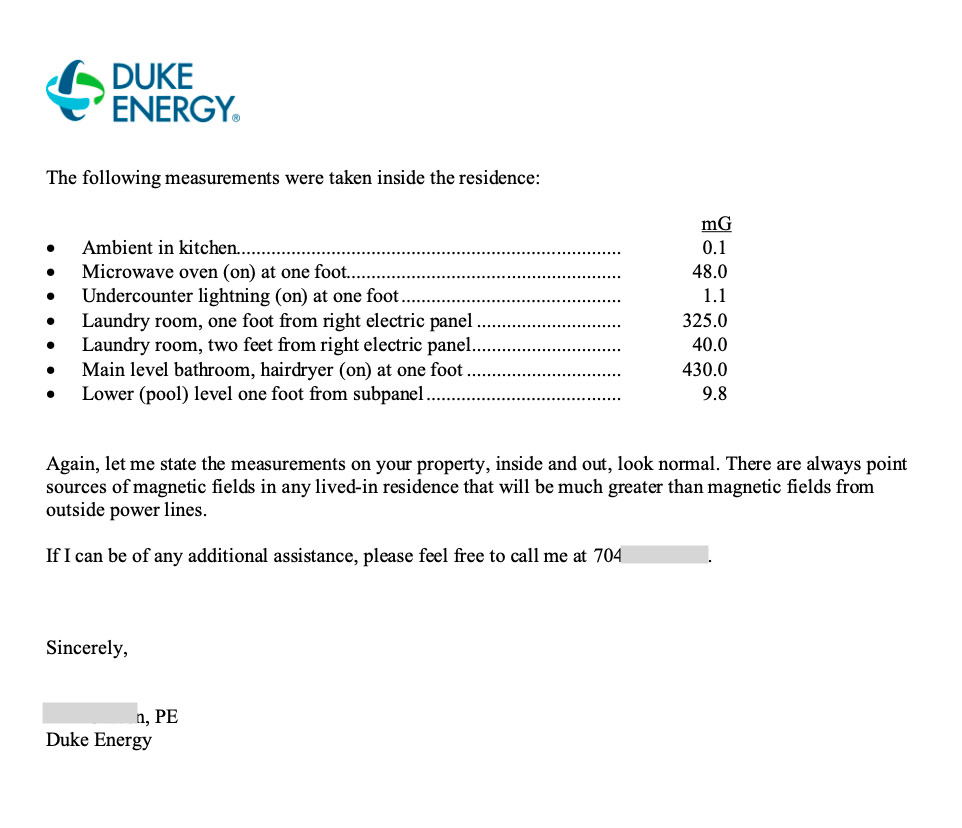
You can see the exact readings from Duke Energy in the letter shown below.
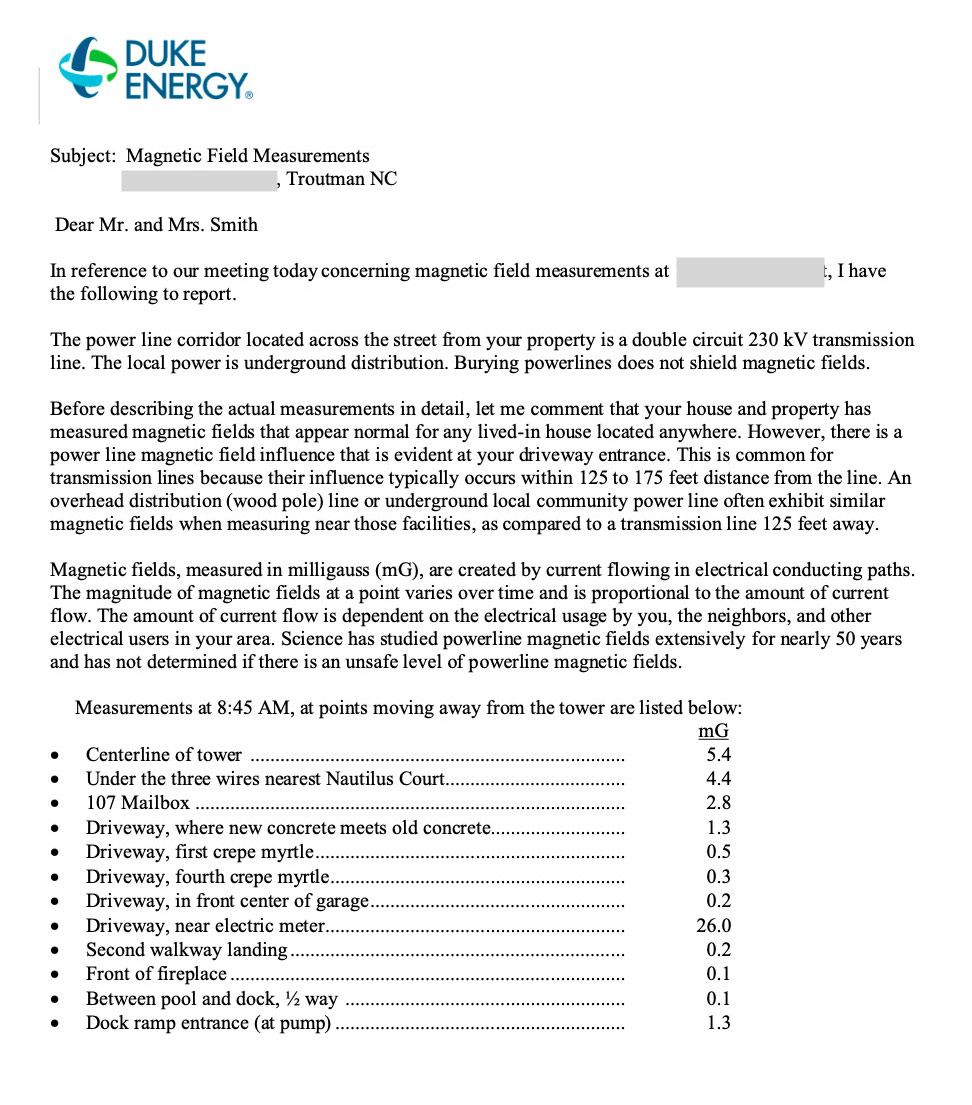
Directly underneath the centerline of the tower—as close as you can physically get to the lines—the magnetic field measured 5.4 milligauss, and it dropped off significantly as measurements were taken moving toward the home. Readings were practically nonexistent as we walked down the driveway. Once we reached the electric meter, the reading increased to 26 milligauss.
Inside the home, the results were even more eye-opening. With the microwave running, the EMF measured 48 milligauss at one foot away. At the electrical panel (breaker box), the measurement was 325 milligauss at one foot, dropping to 40 milligauss at two feet.
And the biggest surprise of all? A standard hair dryer, while running, emitted 430 milligauss Compared to 5.4 directly underneath the lines outside!
You may or may not care about these findings, but I found them interesting—and honestly, very different from what I previously believed.
And Cell Phone Towers?
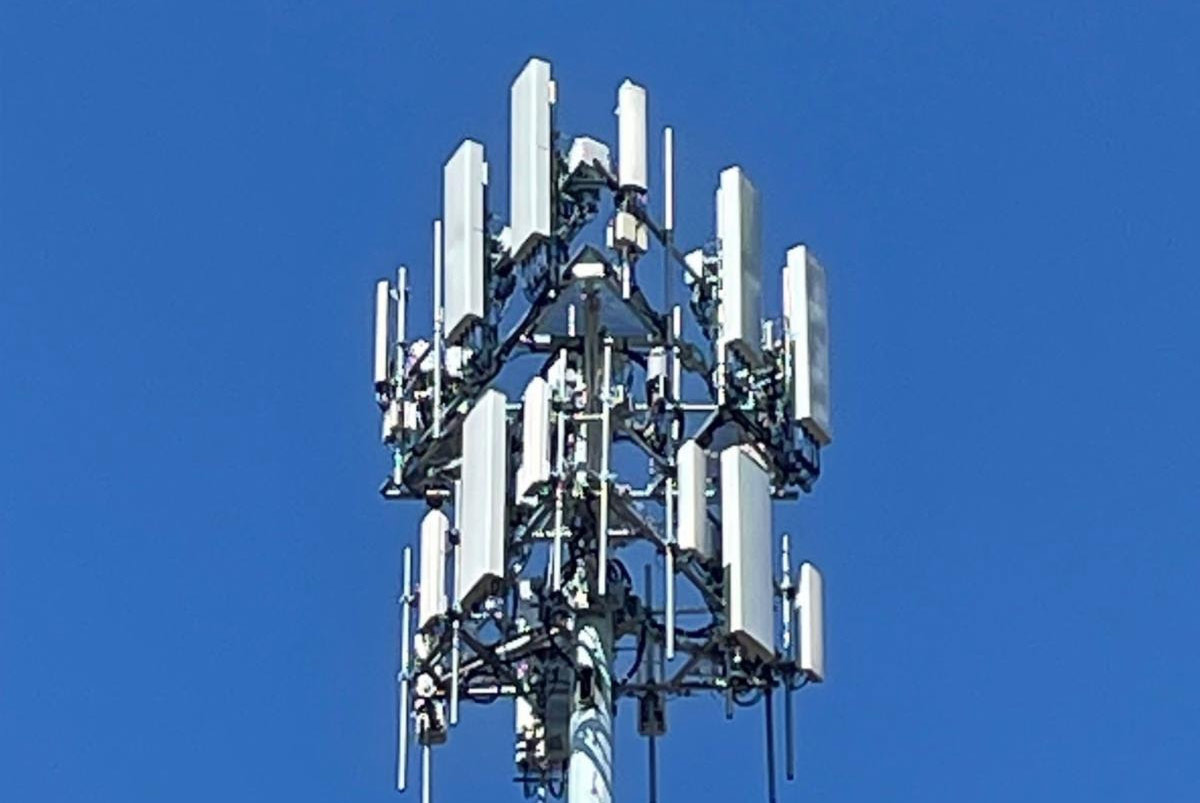
While I was down this rabbit hole, my curiosity naturally led me to cell phone towers as well. I’ve sold plenty of homes near cell towers, and I’ve also questioned the safety of carrying my phone in my back pocket as much as I do.
It’s important to understand that power lines and cell phone towers emit different types of fields. Power lines emit electric and magnetic fields (EMF), while cell phones and cell towers operate using radiofrequency (RF) radiation. The good news is that both EMF and RF radiation are considered non-ionizing, meaning they do not damage DNA. Examples of ionizing radiation would be things like X-rays and gamma rays.
Long story short, when RF exposure is measured in milliwatts per square centimeter, readings taken directly beneath cell phone towers are typically 1,000 to 10,000 times lower than established public safety limits. Cell towers emit very low levels of radiation. The largest exposure most of us receive actually comes from the phone itself, and even that remains well within safety standards. Exposure also varies depending on how and where the phone is being used.
Here’s another thing that surprised me. Many people assume that when a phone has full signal strength, it’s producing the most radiation. The opposite is true. A phone actually emits more power when it’s struggling to connect in low-signal areas. When calls are placed over Wi-Fi, radiation levels are practically nonexistent by comparison.
I’m not a scientist. I’m simply sharing the information I’ve come across and presenting it to the best of my understanding. Use this for general information only, and as always, do your own research if any of this raises concerns for you.
Share this on social media:

Things To Know When Living Near Transmission Lines!
You can’t spend much time around Lake Norman without eventually running into one of these bad boys. After all, when a lake was built for the sole purpose of generating power, you’ve got to be able to move that power to where it’s needed.
These aren’t your everyday neighborhood power lines. They’re high-voltage transmission lines, and in our area they typically operate at around 230,000 volts.
From a real estate standpoint, there are plenty of homes around Lake Norman that sit close to transmission lines. Over the years, I’ve found that buyers usually fall into one of two camps: those who absolutely don’t want to be anywhere near them, and those who couldn’t care less.
I currently have a home listed on Lake Norman that sits roughly 400 feet from a transmission line. After receiving feedback from a potential buyer who was uncomfortable with the proximity, we decided to do something most people never actually do—we brought Duke Energy out to take real-world EMF readings.
They measured EMF (Electro Magnetic Field) levels directly beneath the transmission lines, throughout the yard, and inside the home. They also measured common household appliances for comparison. And to be honest, the results surprised me. I think they’ll surprise you too.
Now, I won’t argue that transmission lines are pretty—they’re not. But I’ve also found that once you spend any amount of time around them, you tend to stop noticing them altogether. More importantly, contrary to what many people believe, these lines pose no measurable health risk to people living nearby.
Before getting into the readings, a little context helps. In the United States, transmission lines typically carry anywhere from 69,000 to 765,000 volts. In North Carolina, the highest-voltage lines in use are 500,000 volts, but the vast majority of transmission lines in and around the Lake Norman area operate at 230,000 volts.
Additionally- while EMF exposure is driven more by current than voltage, voltage is easier for most of us to understand, so we’ll use voltage.
Below are the actual measurements provided by Duke Energy after testing directly beneath the transmission lines and inside the home located approximately 400 feet away. The lines run in front of the house.
Here’s what they found – Keep in mind that the Earths natural magnetic field (which we live in 24/7 is 500 Milligaus.
You can see the exact readings from Duke Energy in the letter shown below.
Directly underneath the centerline of the tower—as close as you can physically get to the lines—the magnetic field measured 5.4 milligauss, and it dropped off significantly as measurements were taken moving toward the home. Readings were practically nonexistent as we walked down the driveway. Once we reached the electric meter, the reading increased to 26 milligauss.
Inside the home, the results were even more eye-opening. With the microwave running, the EMF measured 48 milligauss at one foot away. At the electrical panel (breaker box), the measurement was 325 milligauss at one foot, dropping to 40 milligauss at two feet.
And the biggest surprise of all? A standard hair dryer, while running, emitted 430 milligauss Compared to 5.4 directly underneath the lines outside!
You may or may not care about these findings, but I found them interesting—and honestly, very different from what I previously believed.
And Cell Phone Towers?
While I was down this rabbit hole, my curiosity naturally led me to cell phone towers as well. I’ve sold plenty of homes near cell towers, and I’ve also questioned the safety of carrying my phone in my back pocket as much as I do.
It’s important to understand that power lines and cell phone towers emit different types of fields. Power lines emit electric and magnetic fields (EMF), while cell phones and cell towers operate using radiofrequency (RF) radiation. The good news is that both EMF and RF radiation are considered non-ionizing, meaning they do not damage DNA. Examples of ionizing radiation would be things like X-rays and gamma rays.
Long story short, when RF exposure is measured in milliwatts per square centimeter, readings taken directly beneath cell phone towers are typically 1,000 to 10,000 times lower than established public safety limits. Cell towers emit very low levels of radiation. The largest exposure most of us receive actually comes from the phone itself, and even that remains well within safety standards. Exposure also varies depending on how and where the phone is being used.
Here’s another thing that surprised me. Many people assume that when a phone has full signal strength, it’s producing the most radiation. The opposite is true. A phone actually emits more power when it’s struggling to connect in low-signal areas. When calls are placed over Wi-Fi, radiation levels are practically nonexistent by comparison.
I’m not a scientist. I’m simply sharing the information I’ve come across and presenting it to the best of my understanding. Use this for general information only, and as always, do your own research if any of this raises concerns for you.