
How Do Federal Reserve Rate Hikes Affect Your Mortgage?
Last week, the Federal Reserve raised its benchmark interest rate by a quarter of a percentage point, and almost immediately I started getting the same question: “Does that mean mortgage rates just went up?” It’s a fair question — and one of the most common misunderstandings in real estate.
The short answer is not necessarily.
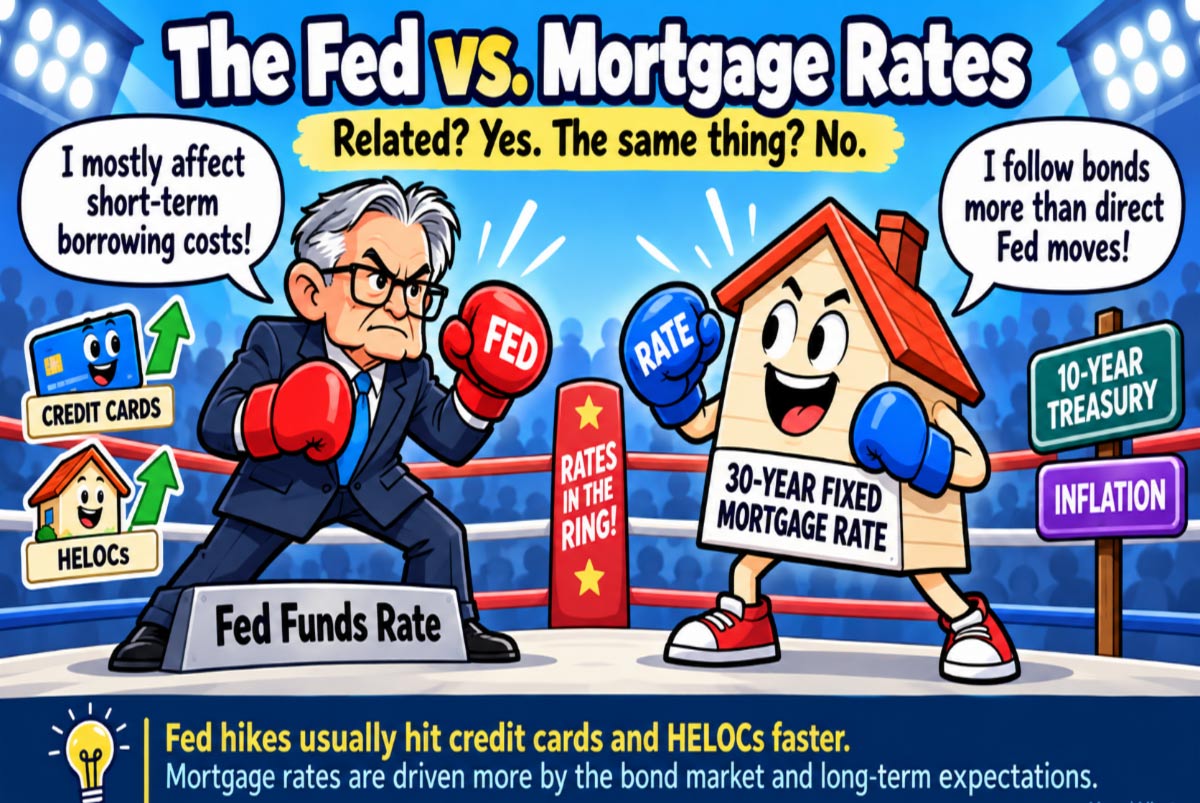
The rate the Fed controls is the federal funds rate, which is the rate banks charge one another for very short-term loans. Changes to that rate tend to show up pretty quickly in things like credit cards, personal loans, auto loans, home equity lines of credit and other variable-rate debt. So if you carry a credit card balance or have a HELOC, that’s where you’re more likely to feel a Fed rate increase first.
A 30-year fixed mortgage is different.
The Federal Reserve does not directly set mortgage rates. Mortgage rates are influenced much more heavily by the bond market, particularly the 10-year Treasury yield, along with investors’ expectations about inflation, economic growth and where the economy is headed. The Fed absolutely influences those expectations, but the two rates don’t move in lockstep. In fact, it’s entirely possible for the Fed to raise rates while mortgage rates stay the same — or even fall — because financial markets often anticipate a Fed decision well before it actually happens.
That said, buyers have had a rough stretch recently.
Mortgage rates pushed above 7% last week, and that number matters psychologically. There’s something about seeing a “7” in front of a mortgage rate that causes a lot of buyers to hit the brakes.
But rates don’t stay in one place forever. If mortgage rates move back into the 6% range — even the high sixes — I think a lot of buyers will suddenly view that as an opportunity. And when that happens, I would expect to see more showings, more offers and more homes going under contract.
That’s why timing matters.
If you’re thinking about buying, now may be a good time to get pre-approved and have everything ready so you can move quickly when rates improve. And if you’re considering selling, a sudden increase in buyer activity is exactly the kind of market you want to be prepared for.
The biggest mistake is waiting until everyone else decides the timing is right. If you’d like to talk through how today’s rates could affect your plans — whether you’re buying, selling or simply trying to understand your options — give me a call.
That’s what I’m here for.
Share this on social media:

How Do Federal Reserve Rate Hikes Affect Your Mortgage?
Last week, the Federal Reserve raised its benchmark interest rate by a quarter of a percentage point, and almost immediately I started getting the same question: “Does that mean mortgage rates just went up?” It’s a fair question — and one of the most common misunderstandings in real estate.
The short answer is not necessarily.
The rate the Fed controls is the federal funds rate, which is the rate banks charge one another for very short-term loans. Changes to that rate tend to show up pretty quickly in things like credit cards, personal loans, auto loans, home equity lines of credit and other variable-rate debt. So if you carry a credit card balance or have a HELOC, that’s where you’re more likely to feel a Fed rate increase first.
A 30-year fixed mortgage is different.
The Federal Reserve does not directly set mortgage rates. Mortgage rates are influenced much more heavily by the bond market, particularly the 10-year Treasury yield, along with investors’ expectations about inflation, economic growth and where the economy is headed. The Fed absolutely influences those expectations, but the two rates don’t move in lockstep. In fact, it’s entirely possible for the Fed to raise rates while mortgage rates stay the same — or even fall — because financial markets often anticipate a Fed decision well before it actually happens.
That said, buyers have had a rough stretch recently.
Mortgage rates pushed above 7% last week, and that number matters psychologically. There’s something about seeing a “7” in front of a mortgage rate that causes a lot of buyers to hit the brakes.
But rates don’t stay in one place forever. If mortgage rates move back into the 6% range — even the high sixes — I think a lot of buyers will suddenly view that as an opportunity. And when that happens, I would expect to see more showings, more offers and more homes going under contract.
That’s why timing matters.
If you’re thinking about buying, now may be a good time to get pre-approved and have everything ready so you can move quickly when rates improve. And if you’re considering selling, a sudden increase in buyer activity is exactly the kind of market you want to be prepared for.
The biggest mistake is waiting until everyone else decides the timing is right. If you’d like to talk through how today’s rates could affect your plans — whether you’re buying, selling or simply trying to understand your options — give me a call.
That’s what I’m here for.